Legal Theory + Reasoning
Course Summary
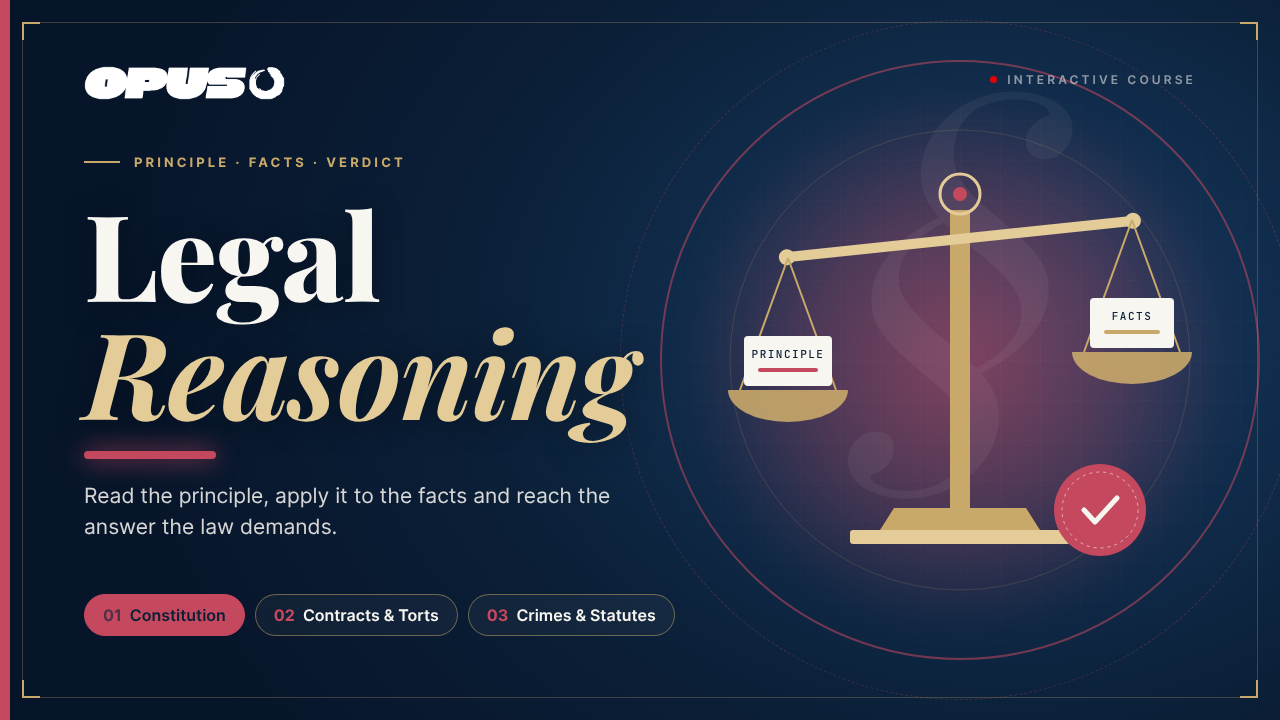
Read a principle, apply it to facts, and choose the ruling that follows: legal reasoning across constitutional, contract, tort, criminal, family, commercial and procedural law.
What's in the course (1st lesson always FREE)
- State a principle in one line, and identify precisely which facts it turns on.
- Choose the ruling that follows from the principle given, even when another outcome looks fairer.
- Apply the core doctrines of constitutional, contract, tort, criminal, family and commercial law to new facts.
- Use maxims and policy arguments the way courts do, as reasoning rather than as slogans.
- Read a long fact pattern once and hold the facts that matter.
- Recognise the option that overstates a principle, or applies it to a fact it does not cover.
The Course Architecture
What's inside.
Legal reasoning is a reading skill before it is a memory test. Each question hands you a principle and a set of facts, and the work is to decide what the principle covers, what it leaves out, and which of the offered rulings follows from it - including the rulings that would be right under a different principle.
The course runs in nine parts: foundations of legal reasoning, constitutional law, the law of contract, commercial law, the law of torts, criminal law and procedure, family and property law, other statutes, and jurisprudence, maxims and policy. Every part teaches the doctrines the questions actually use, then applies them through principle-and-fact questions in the exam's own pattern.
How to use it.
Take the parts in order, because later doctrines assume the vocabulary of the earlier ones. For each question, state the principle in one line before reading the options; then test each option against the facts, not against what feels just. Where you get one wrong, note whether the doctrine was missing or the application was loose.
What students get.
Nine parts covering the doctrines exam questions are built on
Principle-and-fact questions in the exam's own format
Explanations that apply the principle to the facts, choice by choice
Maxims and policy treated as usable rules, not decoration
Reading tools for long fact patterns, with highlights and notes kept
A progress panel that saves answers and position
Learning Outcomes
- Nine parts - foundations, constitutional law, contract, commercial law, torts, criminal law and procedure, family and property, other statutes, jurisprudence and maxims.
- Principle-and-fact questions written in the exam's own pattern.
- Doctrine taught only as far as the questions use it, with the vocabulary later parts assume.
- Choice-by-choice explanations that apply the principle to the facts.
- Reading tools for long fact patterns - highlights and notes that save with your answers.
- A progress panel that saves answers and position automatically.